
December 20, 2025
(From Concept to Distribution — What Creators Need to Know Now)
Artificial Intelligence is already changing how videos are made — but most discussions stop at vague predictions and surface-level hype. By 2030, the transformation won’t be theoretical. It will be operational, measurable, and unavoidable.
This article doesn’t ask whether AI will change video creation. It explains how, where, and what creators, brands, and studios must adapt to if they want to stay relevant.
From the Blank Page to a Working Blueprint: AI in Pre-Production
The most underestimated impact of AI is not automation — it’s decision acceleration.
By 2030, pre-production will no longer begin with brainstorming sessions or scattered references. AI systems will function as creative synthesizers: ingesting brand data, audience behavior, trend signals, and stylistic references to produce ready-to-evaluate concepts in minutes.
Instead of asking:
“What should this video be about?”
Creators will ask:
“Which of these five AI-generated concepts aligns best with our goal?”
Scripts, shot lists, storyboards, and visual styles will be generated as modular options, not fixed plans. Human creativity won’t disappear — it will shift from invention to curation and direction.
The blank page problem won’t vanish because AI is creative. It will vanish because AI removes friction.
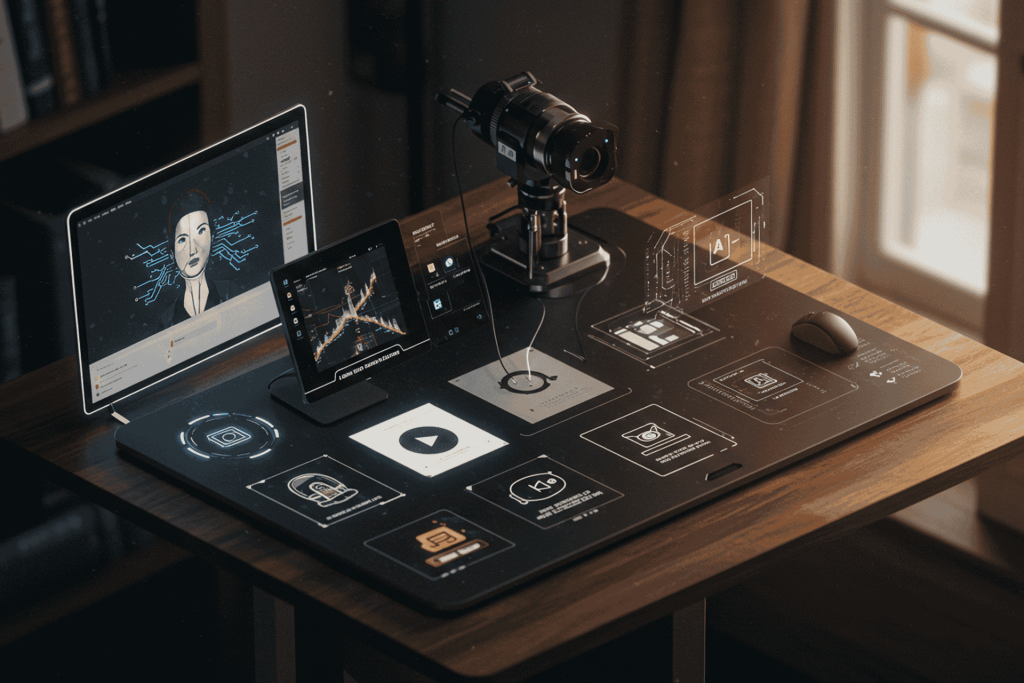
Production Without Cameras: The Intelligent Lens
By 2030, the distinction between live-action and generated footage will matter less than intent and efficiency.
Text-to-video systems will no longer produce “impressive demos.” They will generate cinematic, production-ready scenes with consistent characters, physics, lighting logic, and temporal continuity.
A director won’t describe a scene poetically. They will describe it precisely:
“Medium tracking shot. Overcast lighting. Subtle handheld motion. Emotional restraint.”
AI will translate that intent into visuals — repeatedly, cheaply, and fast.
This doesn’t eliminate cameras. It redefines when cameras are worth using.
For many creators, production will become a strategic choice rather than a logistical burden.
Digital Actors, Virtual Sets, and the End of Location Dependence
Hiring actors, securing locations, and building sets have always been constraints — financial, geographic, and temporal.
AI will turn them into variables.
Digital performers will be generated with controlled emotional range, age progression, language fluency, and visual consistency. Virtual environments will adapt dynamically to narrative needs rather than forcing scripts to adapt to locations.
This won’t replace human performers at the top end. It will replace compromise everywhere else.
Small teams will achieve visual parity with large studios — not because quality standards drop, but because access barriers dissolve.
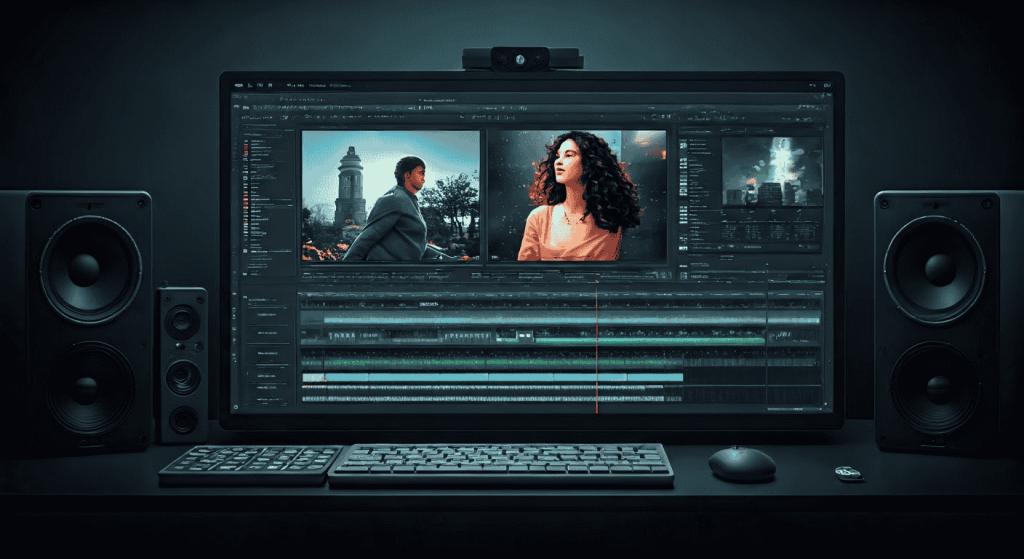
Post-Production as a Creative Act Again
Editing has long been creative in theory and mechanical in practice.
By 2030, AI will absorb the mechanical layer entirely.
Footage selection, sync, pacing, rough cuts, color balancing, noise removal, and even initial sound design will be automated — not generically, but contextually, based on narrative intent.
Editors will stop asking:
“How do I fix this?”
And start asking:
“What emotion should this moment land with?”
Post-production becomes less about software mastery and more about storytelling judgment.
Hyper-Personalized Video at Scale
The biggest disruption won’t be in how videos are made — but in how they are delivered.
Static videos designed for “everyone” will feel obsolete.
By 2030:
- The same video will exist in thousands of variants
- Structure, pacing, visuals, and even tone will adapt per viewer
- Performance data will continuously reshape the content
AI will decide:
- Which version a viewer sees
- When they see it
- How long it should be
- What thumbnail converts best for that individual
Video will stop being a fixed asset and become a living system.
What This Means for Creators
AI will not replace creators — but it will expose who never evolved beyond tools.
The creators who thrive will be:
- Strategists, not button-pushers
- Directors of systems, not operators of software
- Story architects who understand audience psychology
Technical skill alone will lose value.
Creative judgment, taste, and intent will compound.
The Real Shift
The future of video creation is not about machines outperforming humans.
It’s about humans finally being freed from the parts of creation that never required imagination in the first place.
By 2030, the only true limit in video creation will not be budget, tools, or access —
it will be clarity of vision.